Lately when I log into Instagram it feels like my whole feed is videos about AI.
Not AI-generated videos—thank god—but artists and “content creators” informing, critiquing, and making fun of AI. There’s a benefit to these videos, at least on the surface. It’s good to stay informed about the real problems posed by generative AI—data centers, water use, copyright and intellectual property theft. (I don’t need to tell you why AI is a bad thing. You already know, or you should.) And it’s important for artists to insist on a culture that values the real creative work only humans can do. But sometimes I wonder if this influx of AI criticism is helping or just adding to the problem. Sometimes I wonder if we could solve the problem by acting as if it just didn’t exist—like the ending of the 1998 NBC mini-series Merlin: after failing to defeat Queen Mab (Miranda Richardson) through conflict, Merlin (Sam Neill) simply turns his back to her. Without attention, she simply fades away.
Not every problem can be solved by pretending it doesn’t exist. Indeed, the goal of so much political art/content is to draw attention. But where do we draw the line between drawing attention to a problem and amplifying it? What does it mean to respond meaningfully to a situation, rather than to intensify it? That said, some undesirable innovations can be rectified by way of our neglect to give them our attention (Remember the metaverse?) In a media ecosystem that relies on users not just to consume, but to participate and produce, is it a revolutionary act to do nothing at all? To refuse to participate—to keep adding?
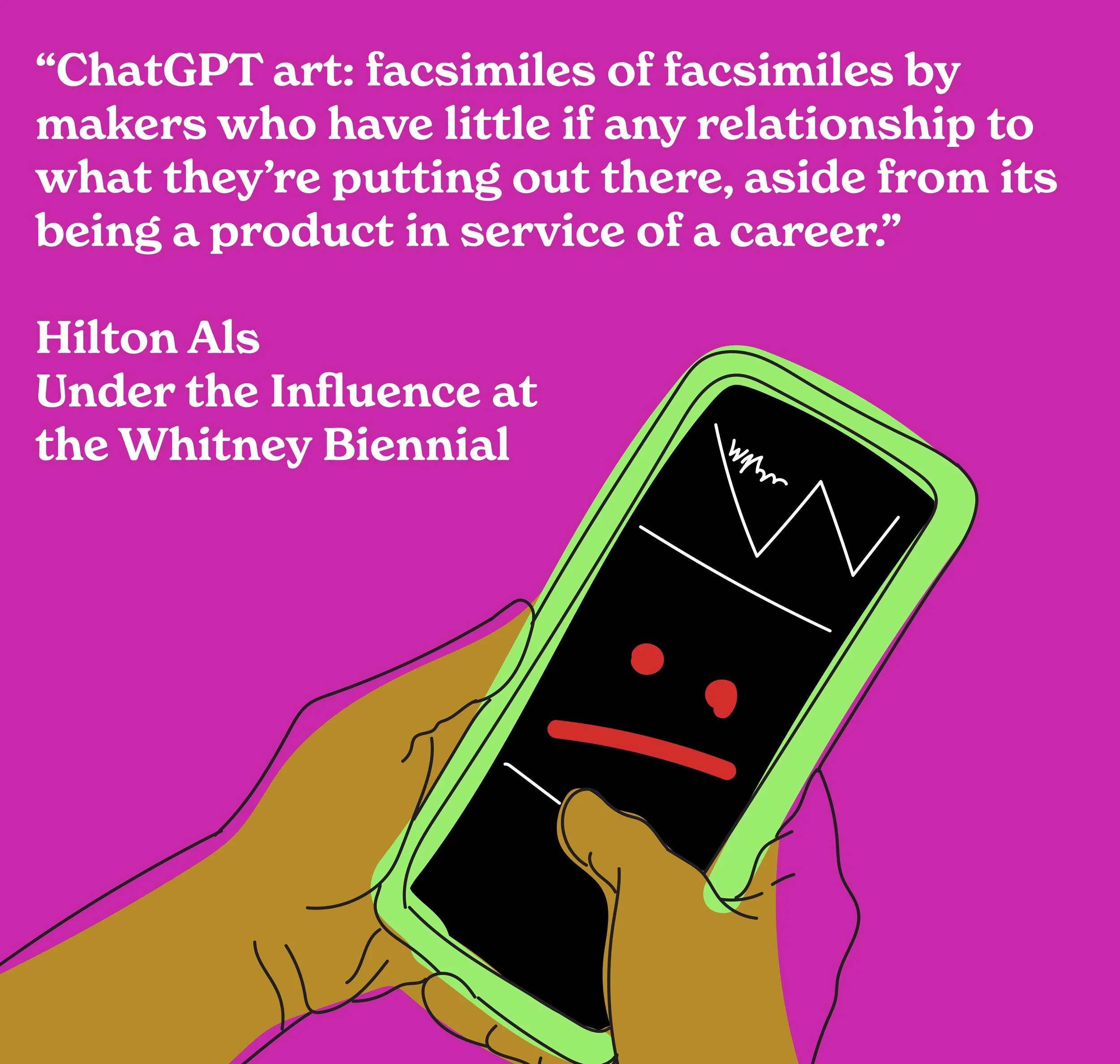
In Hilton Als’ review of the Whitney Biennial, he introduces the term “ChatGPT art” to describe work that mindlessly copies from existing artists. The problem, he says, isn’t repetition itself—good artists copy, great artists steal, after all—it’s that the lack of awareness keeps creative culture locked in a cycle, instead of leading to new ideas. Essentially: art that looks like art.
Other reviews of the Biennial have been ambivalent and divided: praising its forgoing of a central thesis, while also lamenting its lack of clear perspective—the work is both too weird and not weird enough, too political and not political enough. I wonder what it is these writers are looking for and what they mean by political art? More paintings of Donald Trump? Fewer?
In my review of the Carnegie international in 2022, I argued that the artwork was stripped of its meaning because it was contextualized through a political lens. Some people have interpreted that to mean that I don’t like politics in art, but that couldn’t be further from the truth. The problem to me isn’t the existence of politics—all art is political—but a lack of imagination around what political art actually is and can be. When we look at art through a political lens, we can’t help but look through our existing politics, and work necessarily comes to reinforce our own ideas or to contradict them. Images repeat without leading anywhere different. Political art that looks like political art.
The problem with political art and the problem with AI are the same: a lack of imagination. If all art is political, then every creative work offers the opportunity to think about the world in a different way. But it’s easier to keep talking about the same things over and over than it is to say something new. What would it look like to refuse to participate? What new ideas might emerge if we take time to listen, instead of continually churning out more “content”? It may not always be possible to simply ignore the problems caused by AI. And it may be important for art to inform, and to draw attention to the reality of the world around us. But if we can’t get out of the cycle of constant response—even for a moment—then it is impossible to imagine a world that is different, better, than what we already have.
Brent Nakamoto is a Queer, Japanese-American, and Buddhist artist with a background in painting and drawing, printmaking, photography, and book arts. He received his BA from UC Santa Barbara and MFA from Washington University in St. Louis. He currently lives and works in Pittsburgh, PA. He is the Program and Marketing Coordinator for Brew House Arts, where he manages the Distillery Emerging Artist Residency. He is an adjunct faculty member at the University of Pittsburgh, and has facilitated workshops at the Carnegie Museum of Art, Contemporary Craft (PA), Poster House (NY), and Peter’s Valley School of Craft (NJ). He has shown work nationally and internationally, including in California, Saint Louis, New York, Pittsburgh, Helsinki, and Kolkata, and his work is included in the University of Maryland Art Gallery permanent collection. In 2022, he curated “Plain Silk, Uncarved Wood,” an exhibition of eight Asian-American artists living in Pittsburgh, and in 2026 he curated “Stuck in Saṃsāra,” an exhibition exploring themes from the Lotus Sutra. His critique of the 58th Carnegie International was published by Bunker Review in 2023. He is the owner and operator of Almost Perfect Press, a curatorial and publishing project specializing in hand-bound, small-batch publications featuring emerging writers and artists.