The Journal
〰️
The Journal 〰️
Summer 2024 | Vol. 3 / Issue 2
Teacher
Rolfer
Chimney Sweep
Forest Ranger
Kmart Cashier
Travel Guide
Portraitist
Mural Maker
Insurance Salesperson
Broadway Performer
Counselor
Lecturer
Childcare Provider
Translator

Director’s Note
This is a list of the jobs my parents (three artists) did to make money. Throughout my life, I watched them piece together the puzzle that is making a living in the arts. This is not uncommon; artists have always embodied the essence of gig workers, long before the term gained contemporary prominence. From painters in Renaissance workshops to traveling craftsmen and modern-day freelancers, most artists have navigated a rocky pathway to economic survival, without the safety nets of traditional employment.
The image of the starving artist was built on the precarious existence of so many artists—financial instability, lack of benefits, uncertain career trajectories, all of which mirror the challenges faced by gig workers across industries today. Add to that intellectual property issues and competition from AI, and you’ve got a rocky pathway that almost inevitably leads to burnout.
Addressing these labor issues is crucial, not only for the well-being of individual artists but also for society at large. Art enriches cultures, challenges norms, and fosters empathy and understanding. By supporting artists' rights and ensuring fair compensation, we uphold the integrity of creative expression and encourage diversity in perspectives and voices.
This issue of The Journal explores labor across the arts industry, examines the labor that goes into an artwork, and highlights some amazing artists along the way (as always). I hope you find inspiration to continue your own work and the work of supporting artists and their transformative contributions to our world.
Table of Contents
Table of Contents
9 to 5
Hannah Turpin shares examples of artist whose work is about labor and labor practices.
Meet Lataya
Eriko Hattori interviews artist Lataya Johnson, who just completed our Art Handler Apprenticeship.
Putting in Work
Guest contributor Chenoa Baker thinks back on her work in arts labor advocacy and how we can all move forward.
Hardly Working
Kaylani Brown shares examples of artists who solicit a lot of help when “making” their work.
Motivation
Eriko Hattori and Candace Opper reflect on a TASC project that celebrates the legacy of an institution’s labor.
A Harbinger of Doom
Moby Richard reviews a piece of art with a foreboding presence.
Making a Living
Three arts workers weigh in on how to balance joy and work in this economy.
Client Testimonial
Allison White reflects on the ways TASC helped them realize their vision for a project.

A Work of Art or Art at Work?
By Hannah Turpin
Some artists transport us to other worlds and dreamstates through artworks that elicit feelings of free-spirit, wonder, and joy. Other artists engage deeply with the ubiquitous aspects of our everyday lives that, at least in the United States, control and shape our livelihoods: work and labor. Born into a capitalistic system with pre-existing expectations about work and how we prioritize jobs and careers, art challenges us to resist taking these societal patterns at face value and rethink how we apply our knowledge, energy, and resources. And what better environment to consider the work at hand than in an office building, a conference room, a public courtyard space downtown? In the places where we are steeped in the hustle and bustle of working life, let us not slip into the mind-numbing slog or, as Charlie Chaplin showed us in his 1936 film Modern Times, get swallowed up by the machine. Instead, through the lens of an artist, we can take a fresh perspective on our relationship to labor. Below are four examples of living artists who are asking questions about work. Some explore the core facets of labor, be it individual people or inanimate materials; others catalyze our understanding of the labor industry and its impact on communities and social justice. While it may be beyond difficult to fully escape a working life, these artists inspire us to renew our self-awareness about the system we are participating in and commit differently in how we show up.


Vee Adams
How to Fall Apart and Come Back Together, 2019–2021
4 color silkscreen on paper, installation with screenprinted gloves and fabric
@v_adams_prints
Sarah Zapata
Installation detail of Sarah Zapata at The Armory Show 2023, New York, NY
@sylk_z
Nica Ross
noo reality, 2016
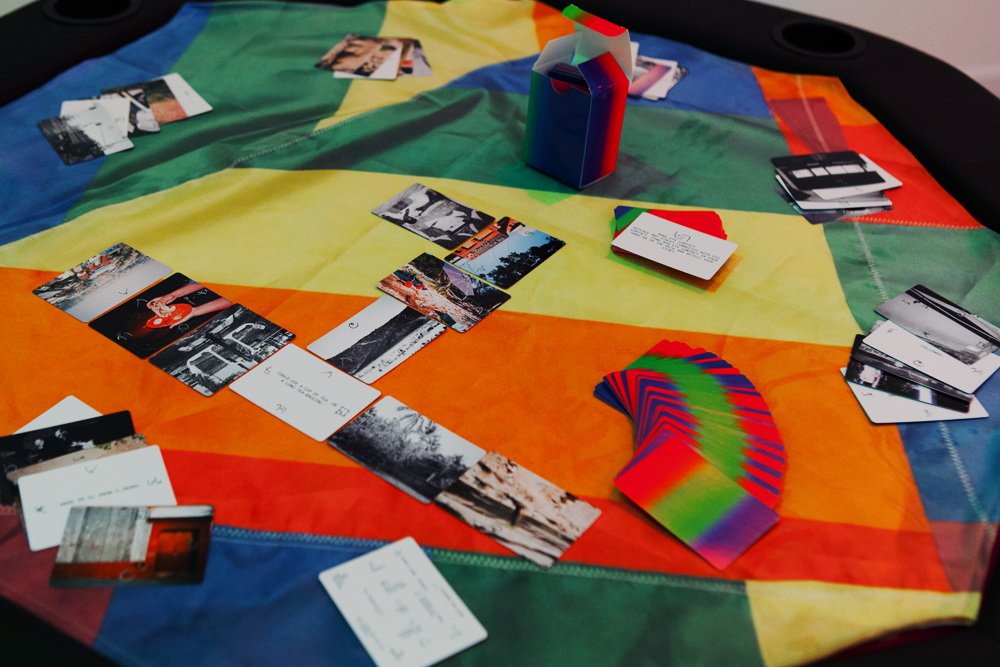
a cloth gayme flag, 156 gayming cards, a digital audio sound track by Geo Wyeth and RGB colored light bulbs
@slimeslam
Pipilotti Rist
Installation detail of Pipilotti Rist: Pixel Forest at New Museum, New York, NY, 2016
@pipilotti_rist_studio

We recently wrapped up our first Art Handling Apprenticeship program.
Over six months, we worked with two apprentices who joined us on various art handling projects, learning the ins and outs of how to handle art properly for display and exhibition. One of our apprentices, Lataya Johnson, is also an artist local to Pittsburgh. Get to know Lataya, and consider bringing her on for a project of your own.
Meet Lataya Johnson
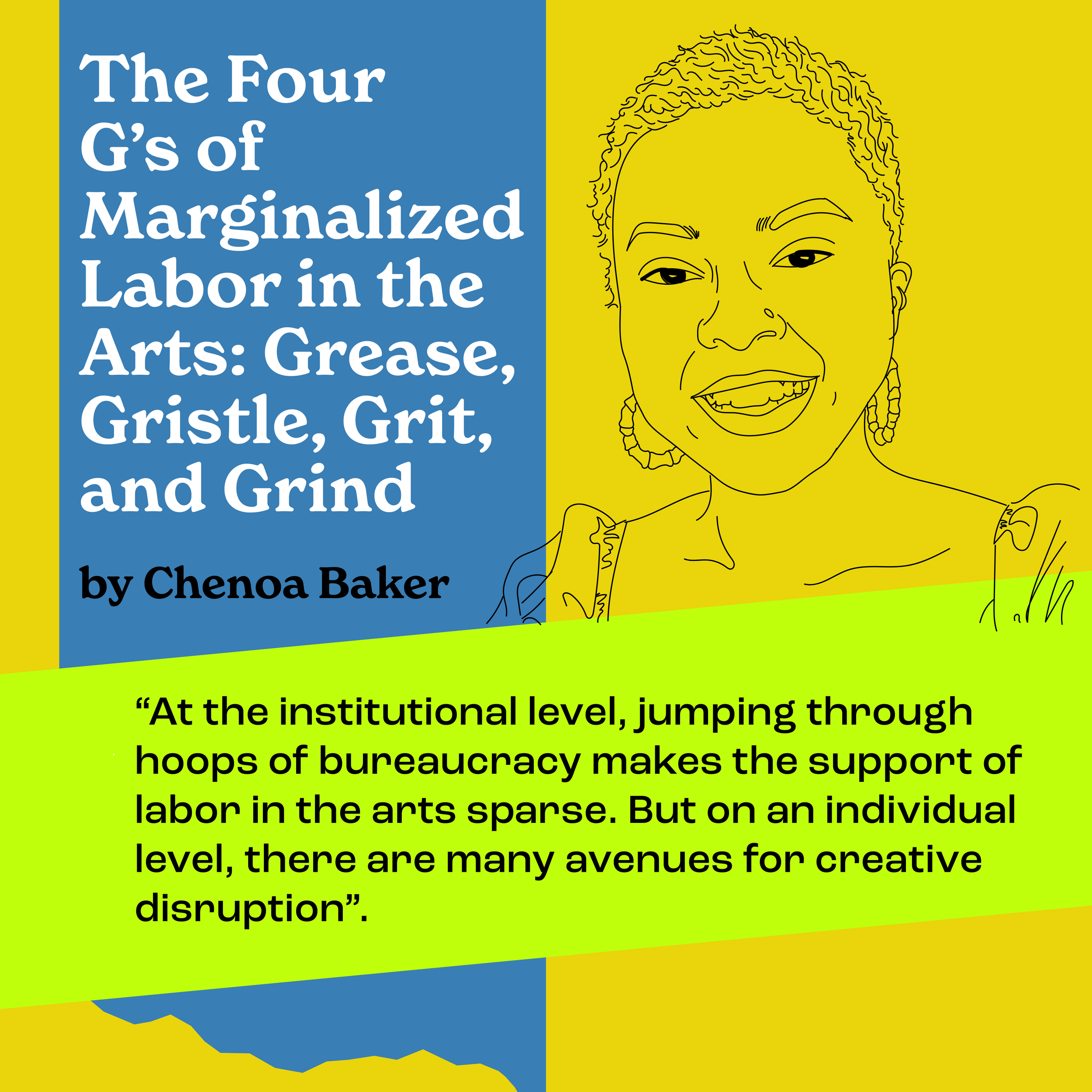
The Four G’s of Marginalized Labor in the Arts: Grease, Gristle, Grit, and Grind
By Chenoa Baker
As an art doula and cultural care worker who nurtures connections through wordsmithing, creative copyediting, curating, and mentoring, ethical curation and the excavation of ancestral labor are the core of my practice. At the institutional level, jumping through hoops of bureaucracy makes the support of labor in the arts sparse. But on an individual level, there are many avenues for creative disruption. I established the following iniatives for cultural workers as models for the caretaking (the root meaning of curating) of labor in the arts.
Who Draws it Anyways?
By Kaylani Brown
When we talk about fine art, we rarely discuss the amount of labor and time that goes into making the pieces.
Artists have employed assistants for hundreds of years (e.g. Leonardo da Vinci, Peter Paul Reubens, and even Michelangelo briefly). Some artists, however, go beyond needing assistance for large projects.
While film and tv make sure to credit everyone’s contributions, why does fine art choose to keep workers in the shadows? At what point in the process do we lose the artist’s hand? Why do so many successful artists turn their practices into machines? Can art only achieve commercial success when it’s produced en masse?
Ruminate on these questions as you peer through this list of seven artists who have outsourced their work.


Workhorse Development

By Eriko Hattori + Candace Opper
As an organization that prides itself on growing and supporting the arts ecosystem, we recognize the labor that goes into every stage of creating art.
Read more about our project with the Community College of Allegheny County’s (CCAC) new Center for Education, Innovation & Training (CEIT).
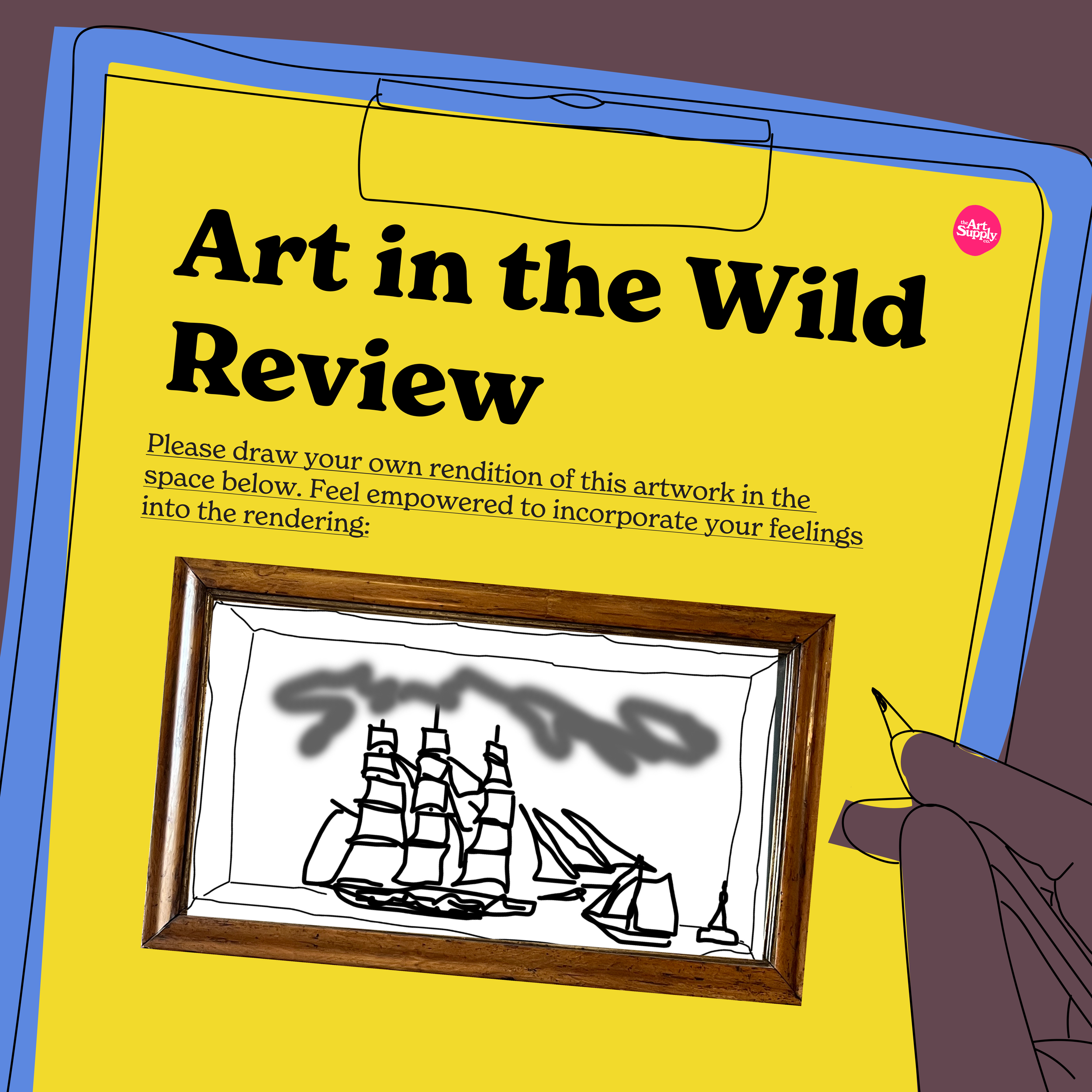
Introducing TASC's Art in the Wild Review, an opportunity for you to release your inner art critic while you're out in the world.
The Art in the Wild Review was inspired by the insipid (or surprisingly beautiful) examples of art you may see in everyday places.
Today’s review was submitted by Moby Richard.
Artwork Location: Coworking space
Medium: Mixed Media
How does this artwork make you feel?: sedated; I get a feeling of impending doom
Describe the artwork in three words: Dark, Stormy, Surprising
Your review of the artwork: “This piece is a strange antique painting/shadowbox that includes a model boat. Inside there is a dark, minimally painted scene with the model sail boats (there are two!) taking center stage. Someone has also propped up what looks like a salt shaker/lighthouse in the corner. They were perhaps a more talented model boat maker than painter-however I will say the framing and hanging of the piece allow you to take it in as an image first and then find a moment of delight as you realize it’s 3D. I tip my hat to the maker of this slightly foreboding mise en scène, may they rest in peace on less stormy waters.

“Working with TASC for the Art in the Heart program at the Skinny Building in downtown Pittsburgh was such an enjoyable experience. Their team was communicative, flexible, creative, understanding, and sharp. Our scope was not clearly defined at the beginning of the project, and TASC worked diligently to help us define and make selections, all within our allotted budget. Their team also was more than willing to go the extra mile every step of the project. Their passion for this work really showed and allowed for this process to be efficient and also fun. We can’t thank TASC enough for bringing our spaces to life through art.”
Allison White
PNC Bank
Client Testimonial: Allison White at PNC Bank

Sophia Marie Pappas. Skinny Building Mural. Photo Credit: Hannah Colen.
How do you maintain the balance between work and joy as an artist or arts worker?
“To me there is no difference between work and joy, or, at least there shouldn’t be. Work should be enjoyable, rewarding, and reflect who we are as individuals, not just employees. That we often fall short of this ideal is an old concern that has recently taken on a new meaning, which we examined in our exhibition Shouldn’t You Be Working? 100 Years of Working from Home, at the Broad Art Museum in East Lansing. Digital technologies and the internet have certainly increased freedom but also eroded boundaries between work and leisure time; they have increased surveillance, micromanagement, and control, even in the arts; and the office itself now occupies formerly private realms. How to keep an open mind amidst all this is an ongoing exploration for me.”
Teresa Frankhaenel, Associate Curator, Eli and Edythe broad Art Museum at Michigan State University
“As a content creator supporting other creatives, I maintain a balance between work and joy by blurring the distinctions dividing them. In professional arts environments, the most productive work conversations often happen during playtime—field trips, happy hours, holiday parties, spontaneous group lunches. Whether as a consultant, employee, labor organizer, or volunteer, I always advocate that these activities are integrated within and inseparable from an organization’s formal meeting structure. And I partake in all the fun, too, of course! The very act of planning for and then participating in such happenings is itself a rewarding blend of work and joy.”
Tom Fisher, Multimedia Producer, Pittsburgh, PA
We reached out to three members of the arts community and asked them how to keep a healthy balance between work and joy as someone who either makes art or supports creators. As a team of artists and arts workers, we understand how much labor goes into this profession and how critical the need for lightheartedness can get. Get some pointers from these three creative workers.
“Scheduling! And saying no. That’s the key to any sense of balance. I love to read. I love to write. I need to write. I need poetry and contemplation to start my day. I need a good breakfast. I meditate. These things bring me so much joy, which I think I deserve. We all do. And, important for me, is that these bits of joy make it possible for me to do my work and do it well!
Balance doesn’t mean 50/50, as we tend to imagine; it’s whatever rituals and routines we make work for us—rituals that keep us whole. More importantly, though, there’s so much joy in my work. I love what I do. That’s the beauty of being an artist, we get to do work we love, with love. Hard, complicated, beautiful, often underappreciated work, still done with love. And, for me there’s no better joy.”
Janera Solomon, curator, writer, mama to a magical being, and so much more. Founder/CEO of ARTPOWER, Inc.