The Journal
〰️
The Journal 〰️
Summer 2023 | Vol. 2 / Issue 2
Director’s Note
What do we mean when we talk about the arts economy?
When I took my one year old for his first blood test, we found ourselves sitting in a waiting room that had an incredible mural with tons of great animals. It was the perfect thing to distract us and it helped calm my anxieties around how he’d react to a needle. It’s easy to take something like this for granted, but I know, from my own work, how difficult it can be to get artwork into spaces like hospitals and how many people are involved in the process. It’s not just an individual artist, but an entire community that makes that happen.
At TASC we think of this collective community as the key members of the arts ecosystem. Building the arts economy is the core of our mission and acts as our guiding light as we pursue client or collaborative projects and create our own. In our work, building the arts economy specifically refers to creating economic growth for the people, businesses, and organizations that make up the arts ecosystem. But what does that actually look like in practice?
It's important to define who we include in the arts ecosystem. At the core, the ecosystem is artists and arts workers—art handlers, curators, framers, arts writers, gallery attendants, and administrators alike. When you branch out to arts businesses or institutions, you’ll find all of the supporting roles, like the people keeping the books, marketing events, or archiving work. Further out are the art supporters—the audiences, collectors, foundations, and other entities that appreciate and engage with the ecosystem.
From a financial perspective, the arts ecosystem is an underpaid field with the majority of workers operating in the gig economy—even when they have full time jobs. Factor in the inequitable conditions that exist across sectors, and it paints a pretty abysmal portrait of life in the arts, particularly for folks who are not cis hetero white men or affluent.
Through our work, we are finding ways to build this arts economy and do so equitably. We’ve focused on paying everyone (a novel concept in the arts) and paying as well as we can. In our spare time, we are working to set better wage minimums for work in the arts. We build in ways to pay artists for proposals, exhibitions, and consulting work. We provide time for mentorship (check out some examples in our last issue of the Journal) and incorporate emerging artists and early-career arts workers into our projects. When we need to engage outside vendors and subcontractors, we prioritize working with independent arts contractors or small businesses that provide the services we need, e.g. printing or framing at local shops instead of large corporate retailers. If we’re designing a publication or planning an event for a client, we consider how we can incorporate artists or arts workers into every phase of the project.
At this point in our journey, we have paid nearly $700,000 into the local arts economy in the Pittsburgh region. We can’t wait to hit the million dollar mark—and beyond. If you’re invested in the concept of shopping local and understand the benefits of doing so, the idea of supporting your local arts economy is not a far leap. Using your resources to support the local arts economy enables it to not only sustain itself, but ideally to grow. Because we all benefit from a thriving arts ecosystem. Whether you enjoy attending an exhibit, purchasing a clever greeting card, seeing a mural on your block, or simply finding something nice to look at in the hospital waiting room—we encourage you to consider all the people needed to make that happen and to nurture that community.

Table of Contents
Table of Contents
Arts at Events
Hannah Turpin discusses the role art can play in events.
NO MORE BLANK WALLS!
Eriko Hattori talks to Max ‘GEMS’ Gonzales about his practice and influences.
Behind the Blob
Graphic Designer David William spoke with us about his role in TASC’s rebrand and tweaking our identity.
Art on the Cheap
Candace Opper reveals how to shop for art affordably while supporting the artists who make it.
Strengthening the Arts Ecosystem
Tara Fay Coleman gets into the nitty gritty of the arts economy.
Pillars in a Strong Arts Ecosystem
Leaders in the arts weigh in on what helps a sustainable arts ecosystem stand on its legs.
Framesmith Testimonial
The Framesmith shares their experiences framing artwork for our projects.
Jules Mallis
Site Specific Installation
October 5, 2022
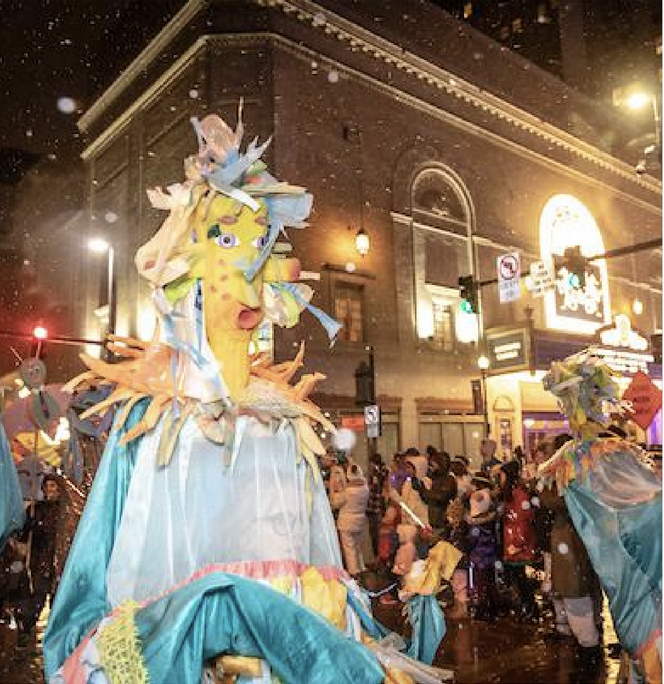
Cheryl Capezutti
Giant Puppet Parade at First Night Pittsburgh.
Photo: Renee Rosensteel
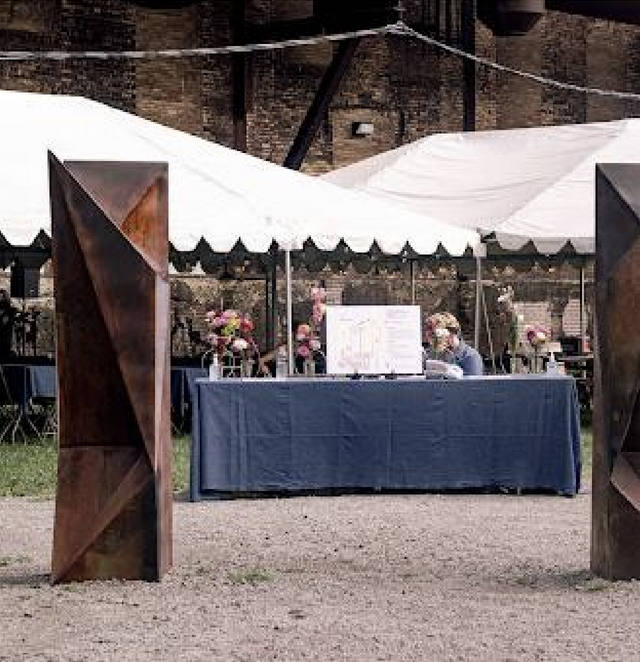
Nick Volpe
Commissioned sculpture for event entranceway at Carrie Furnace.
Incorporating Original Art into Events
By Hannah Turpin
Parties often have the expectation to be lighthearted and freewheeling—dare I say even wild.
They can also be traditional, full of beauty and sophistication. As you plan, you consider food and drinks, invitations, flowers and linens, layout and venue. But have you ever considered the element of art? How can incorporating the eye of an artist into your event make it something truly unique and memorable?
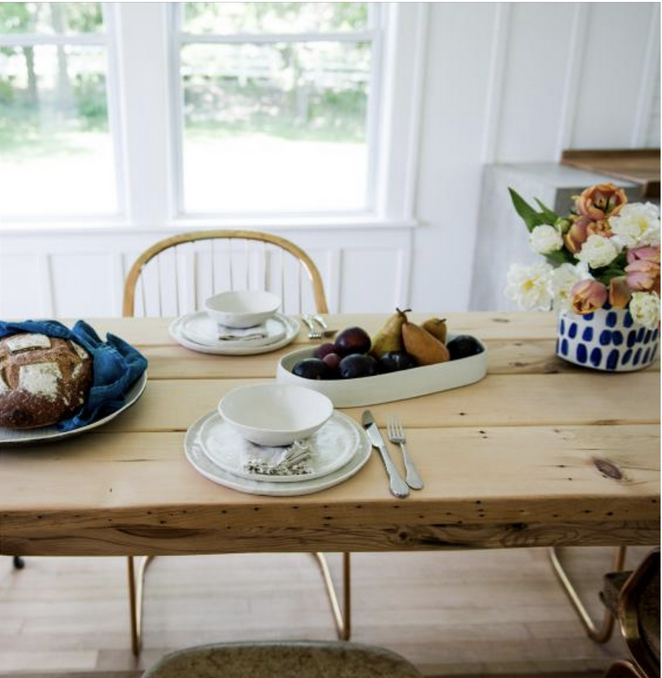
At TASC, we include artist-driven elements as regular part of our event planning for clients. Part of the excitment of working with artists is that the possiblities are endless; they can either add something flashy or, alternatively, be a more subtle substitution for a detail you were already planning to include. Objects like dishware, vases, tablecloths, and invitations are most likely already on your list, but with the touch of an artist-made design, they can shift from a mass-produced standard to something personalized. Show-stopping centerpieces, entrance way sculptures, or even digiral projections created by artists transform an atmosphere enlivening the gathering with a particular mood and compelling aesthetic. Lastly, for moments where you really want to engage your guests, artists can facilitate phenomenal activities such as screen rpinting bandanas at a summer picnic for a one-of-a-kind takeaway, or constructing puppets and costumes for an all-inclusive finale of the night parade. To elevate your party from ordinary to extraordinary, check out a few artists we’ve worked with in the past.
Reiko Yamamoto
Ceramic works situated on a table.
Photo: Alexandra Ribar

NO MORE BLANK WALLS!
Meet Max GEMS Gonzales
Max Emiliano Gonzales—also known by their artist name “GEMS”—can be classified as an activist, art educator, muralist, graffiti writer, printmaker, curator, and more.
Originally from the Southwest side of Chicago, and raised in Latino communities, Gonzales came to Pittsburgh in 2012 to attend Carnegie Mellon University’s Fine Arts program on a full-ride scholarship. by 2016, they had graduated with honors, secured multiple positions with the University , and been arrested as Pittsburgh’s most wanted graffiti artist.

Behind the Blob
By Eriko Hattori
As a part of our rebrand into The Art Supply Co., we wanted to come off as bold, memorable, and true to ourselves and our work.
We’ve previously worked with David William for websites and design on projects, and were excited to work with him again as The Art Supply Co. came to fruition. Get to know David and how he shapred the look and feel of TASC.
Original Art on the Cheap
By Candace Opper
The phrase “affordable art” may conjure images of the botanical canvases and framed cityscapes that fill the home decor departments of Target and IKEA.
While mass market art is certainly one afordable way to decorate your space, it is definitely not the only way—or even the most economically savvy. buying original art locally or directly from artists online can allow you to frgually fil your space with amazing, one-of-a-kind art on a budget.
Strengthening and Cultivating the Arts Ecosystem
By Tara Fay Coleman
We view an arts ecosystem as something that functions as a diverse community of artists, arts workers, organizations, and audiences, all interacting and contributing equitably.
What do you think are the key pillars needed to build a sustainable arts ecosystem?
By Hannah Turpin
We reached out to three arts stakeholders in the region to get their opinion on structuring a supportive arts ecosystem and making it sustainable. What are the main elements that keep everything held together and standing? Check out how these arts leader weighed in.
“Collaboration is first and foremost in my mind. This includes not only collaboration between artists and organizations, such as the Office for Public Art, but also the collective work of other fields—the fabricators, designers, landscape architects, engineers, social workers, educators, community members, and so many more that make the artworks possible. When we successfully tell the stories of hte collaborations anf shine the spotlight on thier importance, more people see themselves as part of and invested in the ecosystem. They become advocates for the work of artists and for additional resources that make the ecosystem thrive.”
Sallyann Kluz, RA | Executive Director, Office for Public Art, Pittsburgh, PA
“Sustaining artistic energies requires ensuring artists are thriving. Perhaps a place to start is to assess what’s urgently lacking in the livelihoods of cultural workers. Some of these are things the larger community might be able to support with, like gigs, insurance, studio or rehearsal space, legal and business advice, exhibition and performance opportunities, inclusion on panels, governmental committees, or advisory boards, access to tools and technology, etc. Needs ot be met. If needs are not met, then art will not have a place in people’s or governments’ priorities. Art is a powerful organizing tool and can be an active buffer against poverty, carceral logics, bigotry, environmental ruin, and so much more. It’s the first thing to get cut but has some of the most incredible and life-affirming potential. For this reason, artists need to be involved in the health of their communities, and communities need to welcome them in and reciprocate that care. We are nothing without each other.”
Latham Zearfoss, Artist, Chicago, IL
“The best way to nurture the arts is to support artists in the community. This requires paying a living wage for their work. It also means investing in arts training for the young, STEAM over STEM. The arts must also be accessible to all, including those without the means to pay for tickets to increase support for the arts, improve lives, and make our communities safer and more equitable. This may sound as if it contradicts the advice to pay artists, but it doesn’t have to. We should encourage the government, philanthropic foundations, and individuals with means to subsidize arts access for all to strengthen our communities.”
Sarah Jacobs, Artist at Sarah Jacobs Art, Erie, PA
Client Testimonial: Ryan Seals at The Framesmith
“The team at TASC has been a delight to work with as they operate with the highest standard of professionalism in the community. They know and live in the world of art and design, and their roots grow deep. Every project has unique challenges, and it’s essential to make proper decisions for the client and the art. As a custom frame shop we deal with it everyday, and it’s a dream to work with a company taking it to the next level. Their work is exceptional.”
Ryan Seals, Owner, The Framesmiths, Pittsburgh, PA