City Parks and Recreation: Art in Pittsburgh Parks
By Hannah Turpin
Public art presents an opportunity for individuals to immerse themselves in art during their everyday routines. It heightens art’s accessibility within different communities, fulfilling the ideal that art truly is for everyone and something we all can experience and enjoy. Instead of being preserved and protected within the walls of an institution, public art invites people to directly engage with it, inviting play and conversation.
What exactly goes into developing a public art project with the city? The Art Supply Co. (TASC) recently experienced this process firsthand, after partnering with the City of Pittsburgh’s new Art in Parks initiative—a project commissioning object-based sculpture, site-specific installations and landscape works in each of the five Allegheny Regional Asset District (RAD) parks. This program is made possible by the RADical ImPAct Grant, which was launched in celebration of the Allegheny Regional Asset District’s 25th anniversary, with the intention of funding bold, forward-looking, creative projects that will have a radical impact on the region. Spearheaded by Public Art & Civic Design Manager Sarah Minnaert and Arts, Culture, and History Specialist Anthony Cavalline, the City identified eight artists or art teams to fulfill the project’s mission.
The Art Supply Co. was brought onto this project as an expert collaborator. Acting as project manager, TASC worked closely with the City’s team and the artists to bring the public art pieces from idea to creation by providing administrative support for the design, fabrication, and installation of the new artworks in each park. In addition, TASC led a parallel storytelling project to enhance community involvement in the art’s development. Our team selected five storytellers and paired each with one of the parks. Throughout the project, the storytellers observed and documented the artistic process and the community’s involvement, resulting in a variety of creative responses that range from essays to videos to illustrations.
Over the course of just one year, TASC helped manage processes and people, a role project manager Dave Zak cheekily described as being like “a talking spreadsheet.” This endeavor required perseverance, clarity of concept, community buy-in, and lots of discussion. After the city assigned the selected artists a specific park and budget, TASC stepped in to arrange opportunities for research and conceptualization. We conducted site visits and meetings with park rangers for location scouting and connected with neighboring individuals, businesses, and organizations for input on their personal engagement with each park. The Pittsburgh Parks Conservancy—a nonprofit that champions Pittsburgh’s city parks and supports their maintenance and improvement—played a significant role in project planning. Their depth of knowledge about the parks’ respective history, ecology, and uses enhanced each project’s organic integration into the assigned setting. Whether researching water in the park landscape and discussing findings with a watershed supply expert, or identifying a metalsmith to support an artist through a new sculptural process, TASC supplied a vast network of resources to support the artists in achieving their visions.
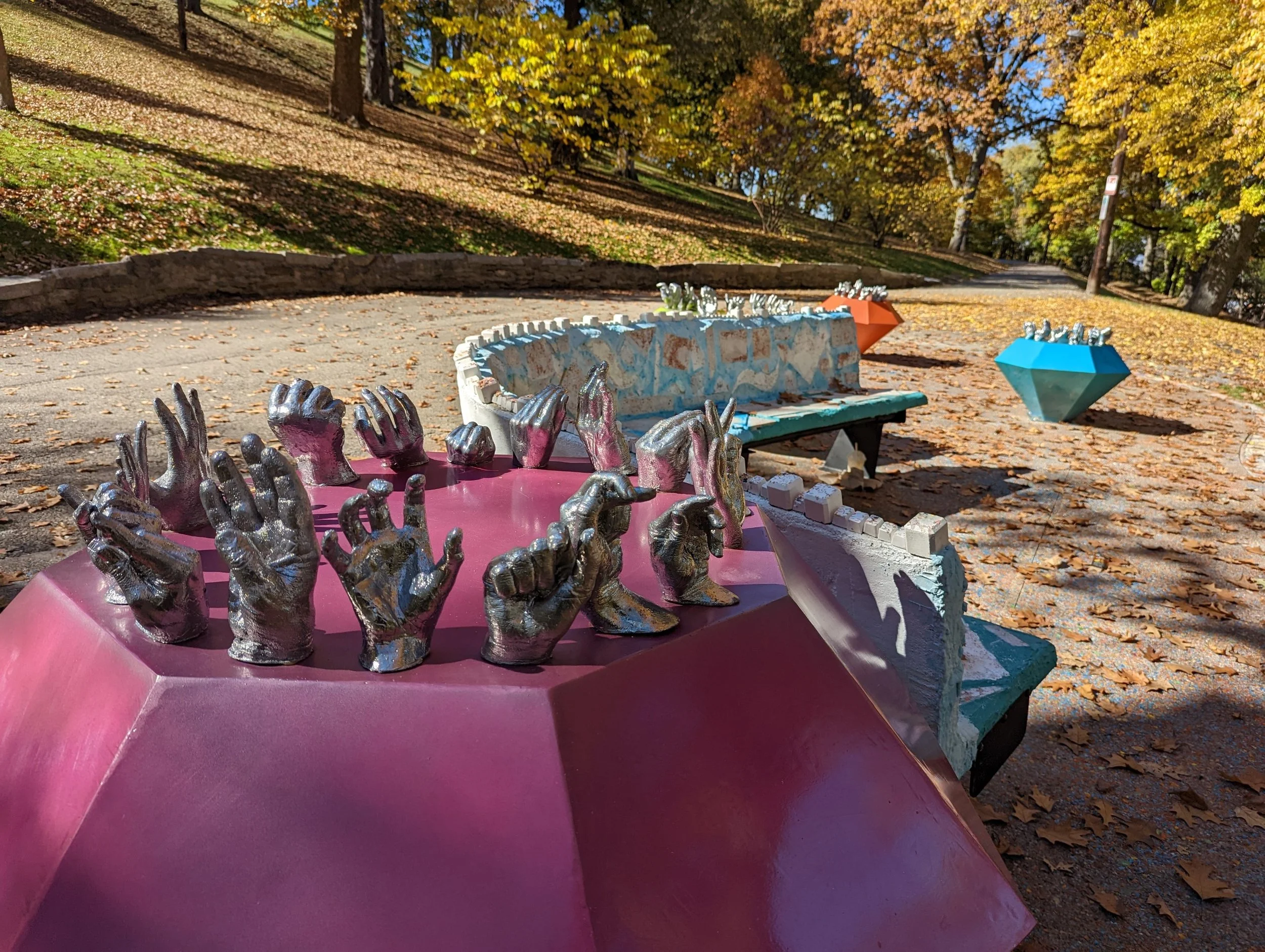
A Monument to Pittsburgh Youth by Ali Ruffner, photo courtesy of the City of Pittsburgh
Emerald View Park
Artist: Ali Ruffner
Ruffner’s A Monument to Pittsburgh Youth is a casting of Brashear High School students’ hands and ceramic tiles that the artist completed following a year-long engagement with the students.
Artist: OOA Designs
Woman-owned and operated OOA Designs crafted a sculptural trellis of scrap metal inspired by James Oppenheim’s poem “Bread and Roses” and post-industrial transformation.
Storyteller: Sandra Bacchi
A Brazilian multimedia artist based in Pittsburgh, Bacchi will shoot a short documentary video to tell the story of Emerald View Park.
Frick Park
Artist: Hutabut LLC
Hutabut LLC is designing a functional, participatory artwork akin to the whimsy of a merry-go-round that visually references the castle-like entrance of the park’s original estate.
Storyteller: Sophia Fang
A queer, Chinese-American interdisciplinary artist working between both Pittsburgh and Seattle, Fang will paint a series of watercolors illustrating the story of Frick Park.
Highland Park
Artist: Marlana Adele Vassar
At the park’s reservoir entrance, Marlana Adele Vassar has created sculptures in conversation with the more austere, classical statues already present. These new pieces show non-white figures coexisting with nature rather than trying to tame it.
Artist: The Urban Conga
Near the park’s public pool, The Urban Conga designed Together, a playable communal platform encouraging social interaction that recalls the park’s history of having one of the city’s first integrated pools. Highland Park remains one of the most diversely used parks in Pittsburgh.
Storyteller: Alyssa Velazquez
A cultural historian based in Pittsburgh, Velazquez will design a downloadable zine to share the story of Highland Park.

Drip, See, Run by Ginger Brooks Takahashi, image courtesy of the City of Pittsburgh
Schenley Park
Artist: Ginger Brooks Takahashi
Ginger Brooks Takahashi installed Drip Seep Run, which explores humans’ relationship to water by making visible the presence of natural water seep channels running down the hill.
Artist: Suphitsara Buttra-Coleman
Suphitsara Buttra-Coleman created a two-part paneled mural responding to the climate crisis’s impact on birds and “us[ing] this opportunity to remind city visitors of the wildlife in their backyard.”
Storyteller: Sakena Washington
A creative writer and digital content creator based in Pittsburgh, Washington will write a narrative essay to tell the story of Schenley Park.
Riverview Park
Artists: Sans façon and Steve Gurysh
Sans façon and Steve Gurysh are developing Pictures of the Future, a multi-faceted public artwork with various entries to engagement, which uplifts the unheard story of a group of “heritage trees” that have existed before and throughout the entire life of the park.
Storyteller: Mark Kramer
A narrative journalist, essayist, and writing instructor based in Pittsburgh, Kramer will tell the story of Riverview Park through a series of short essays.
The Art in Parks project required a minimum four-step meeting protocol for each artist or artist group, including one meeting with the Registered Community Organization for each of the park’s geographic communities, one virtual public forum, and two meetings with the City’s Art Commission—a group whose members “represent different disciplines that contribute to the quality of civic design and the public realm.” Formal approval from the Art Commission is needed for any structure erected on city-owned land to be actualized. TASC tracked the progress of each step, noting any points of feedback for deeper research and more detailed planning. Our project managers maintained detailed schedules and moderated each budget, while also remaining adaptable to the discoveries and unexpected challenges that arose during this complex, multi-stakeholder process. “[TASC]’s team kept my project on track,” says Art in Parks artist Ginger Brooks Takahashi, “organizing all the necessary deadlines and documents, so I could stay focused in my process.”
The eight approved projects are scattered amongst the City’s two thousand acres of grassy escapes. They offer different qualitative experiences reflecting the bordering neighborhoods, the surrounding community, and the natural life that defines each park’s ecology. Each project is unique to the artists and the sites, thus requiring a wide array of problem-solving and strategizing. “Working with [TASC] was essential to making this project happen,” attests the City’s Art in Parks co-leader Sarah Minnaert. “The team was able to support and advocate for artists, make connections with other creators and fabricators in our community, and apply best practices and linked connections to help us realize this series of artworks and accompany storytelling.” Planning for major installations and art projects that involve multiple layers of approvals, progress reports, and community engagement requires the expert skill set of project managers. By tackling the demanding process and maintaining the utmost organization, TASC paved the path for Art in Parks artists to enhance the creative research and art-making they do best and ultimately deliver a series of compelling new artworks for the public to welcome into their everyday routines and spaces.